
How to Dab Concentrates: A Complete Guide for Beginners
Cannabis concentrates, often just called “dabs,” are some of the most potent products on a dispensary menu. A single rice-grain-sized dose can deliver effects that would take a full bowl of flower to match, and the variety has exploded in recent years. Walk into any dispensary today and you’ll see shatter, wax, live resin, live rosin, diamonds, sauce, badder, and distillate sitting on the same shelf, each with its own texture, flavor, and ideal way to consume it.
Quick definition: A “dab” is a small, single-serving dose of cannabis concentrate that’s vaporized on a heated surface and inhaled through a water pipe or electronic device. Concentrates typically range from 60% to 99% THC, compared with 15–30% for flower.
What are cannabis concentrates?
Cannabis concentrates are extracts made by separating the cannabinoids (THC, CBD, minor cannabinoids) and terpenes from the plant material they grow on. What’s left behind is a highly potent product that delivers the effects and flavor of cannabis without the leaf, stem, and combusted plant matter you inhale when smoking flower.
Because concentrates contain far less inert plant material, they’re significantly stronger by weight than flower. Most concentrates test between 60% and 90% THC, and some, like diamonds and distillate, can push 95% or higher.
The practice of concentrating cannabis isn’t new. Hashish and kief have been used for centuries. What’s changed is the technology: modern extraction methods produce concentrates with consistent potency, defined terpene profiles, and far higher purity than anything available a generation ago. Today’s dab scene took shape in the late 2000s and early 2010s as butane hash oil (BHO) techniques became more refined, and it continued evolving with solventless options like rosin and live rosin.
Solvent vs. solventless extraction
Before getting into individual concentrate types, it helps to understand the two broad categories every extract falls into. This single distinction tells you a lot about how a concentrate was made and what to expect.
Solvent-based concentrates use a chemical solvent, typically butane, propane, or CO₂, to strip cannabinoids and terpenes from the plant. The solvent is then purged with heat and vacuum, leaving the concentrate behind. Shatter, wax, budder, crumble, live resin, sauce, and distillate are all solvent-based. When done properly in a licensed lab, residual solvent levels are well below state safety thresholds. Reputable dispensaries only stock concentrates that pass third-party lab testing.
Solventless concentrates are made using only physical methods: heat, pressure, ice water, or agitation. No chemicals are involved. Rosin, live rosin, hash, ice water hash, and kief are all solventless. These tend to cost more per gram because the process is labor-intensive and yields are lower, but many consumers prefer them for the clean production method and full-spectrum flavor.
Neither category is universally “better” — it comes down to your preference for flavor, price, and production method.
Types of concentrates explained
Here’s a breakdown of the concentrate types you’re most likely to see on a menu today.
Shatter
Shatter is a glassy, translucent concentrate that looks like amber-colored hard candy. At room temperature, it snaps cleanly when broken, which makes portioning easy. It’s typically made by leaving butane-extracted oil undisturbed during purging so the molecules align into a stable, sheet-like form. Shatter is generally THC-dominant (70–90%) with a moderate terpene profile and is a classic, budget-friendly option.
Wax
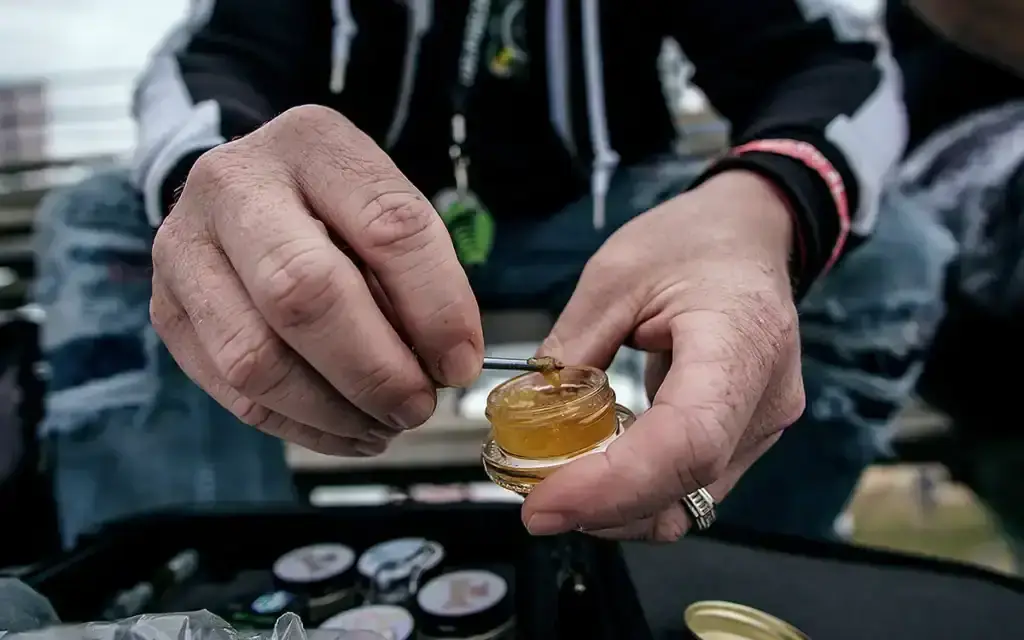
Wax is a softer, opaque concentrate with a texture that ranges from sticky and pliable to dry and crumbly. The difference comes from how the extract is agitated during purging. You’ll see it sold as plain wax, crumble (drier, breaks apart easily), or honeycomb (porous and brittle). Wax is easier to scoop than shatter but harder to portion precisely.
Budder and badder (batter)
Budder and badder have a creamy, cake-frosting consistency that’s earned them comparisons to peanut butter or whipped icing. They’re whipped during the purge to introduce air and create that soft texture. Budder tends to be thicker; badder is looser. Both are prized for strong terpene preservation and a smooth, flavorful dab.
Live resin
Live resin is made from cannabis that’s flash-frozen immediately after harvest instead of being dried and cured. Freezing preserves the volatile terpenes that would otherwise evaporate during drying, resulting in a concentrate with an exceptionally aromatic, true-to-strain flavor. Live resin usually has a sauce-like or batter-like texture and typically tests in the 65–85% THC range with rich terpene content.
Rosin and live rosin
Rosin is a solventless concentrate made by pressing cannabis flower (or hash) between heated plates. Live rosin uses fresh-frozen material, which is the same starting point as live resin, but with a fully solventless process. Live rosin is considered the gold standard by many connoisseurs for its flavor and purity, and it commands premium pricing to match.
Diamonds and sauce
Diamonds are crystalline structures of pure THCA that form during a specialized extraction process. They’re often sold submerged in a terpene-rich liquid called “sauce”. This combination is usually labeled diamonds and sauce or HTFSE (high-terpene full-spectrum extract). Diamonds alone can test above 95% THCA, making them among the most potent concentrates available. Sauce delivers the flavor; diamonds deliver the punch.
Distillate
Distillate is a highly refined oil that’s been stripped of nearly everything except a single cannabinoid, usually THC. It’s clear, almost odorless, and extremely potent (often 85–95% THC). Because the terpenes are removed during distillation, distillate has very little native flavor and is usually re-infused with terpenes for cartridges, edibles, and infused products. It’s less common as a stand-alone dab.
Hash and kief
Hash is one of the oldest forms of concentrate in the world. Modern dispensary hash typically refers to bubble hash (ice water hash). The trichomes are separated from the plant material using ice and agitation, then dried and pressed. It’s solventless, full-spectrum, and milder in potency than most modern extracts (40–60% THC), making it a good entry point. Kief is the loose, powdery resin glands that collect at the bottom of a grinder and can be sprinkled on flower or pressed into rosin.
Quick comparison: For beginners, live resin offers the best balance of flavor, potency, and price. Rosin and live rosin are the picks if you want solventless. Shatter and wax are the most budget-friendly. Diamonds are for experienced consumers chasing maximum potency.
Dabbing equipment: what you need
The dab rig market has changed significantly. The domed-nail setups that defined early dabbing have largely been replaced by quartz bangers and carb caps, and electronic rigs have made dabbing far more accessible to newcomers.
Dab rig
A dab rig is a water pipe specifically designed for vaporizing concentrates. It looks similar to a bong but is typically smaller, with a recessed joint that holds a banger or nail. Smaller rigs preserve flavor; larger rigs cool the vapor more.
Quartz banger
The banger is the bucket-shaped piece where concentrate is vaporized. Quartz is the current standard as it heats evenly, retains heat well, and doesn’t impart flavor. Titanium and ceramic alternatives exist but are less common today. A quality banger lasts longer and produces consistently better dabs than a cheap one.
Carb cap
A carb cap is a small lid that goes over the banger after the dab is loaded. It restricts airflow, lowers the vaporization pressure, and ensures the concentrate fully vaporizes at lower temperatures. Carb caps are essential for low-temp dabbing and dramatically improve flavor. They’re inexpensive and worth owning from day one.
Dab tool
A dab tool (sometimes called a dabber) is a small metal or glass implement used to transfer concentrate from the container to the banger. Different shapes work better for different textures, like scoops for badder and wax, picks for shatter.
Torch
A butane torch heats the banger to dabbing temperature. Standard kitchen-style torches in the 1,500–2,000°F range are appropriate. Larger torches heat faster, but make it easier to overheat the quartz.
E-rigs and e-nails
Electronic rigs (e-rigs) and electronic nails (e-nails) eliminate the need for a torch entirely. They use battery- or wall-powered heating elements set to a precise temperature, take the guesswork out of dabbing, and are widely recommended for beginners. Popular options include the Puffco Peak, Dr. Dabber Switch, and Pulsar RoK. They typically cost $200–$400.
Dab pens (vape pens)
Dab pens are portable, pen-shaped vaporizers designed for concentrates. They work well with wax, shatter, and some live resins, are discreet, and require no torch. They generally don’t deliver the same flavor or vapor quality as a rig, but are an excellent on-the-go option.
Optional accessories
- Terp pearls — small ceramic or quartz beads that spin inside the banger to distribute concentrate and improve vaporization
- Insert cups — small quartz cups that hold the concentrate inside the banger, making cleanup easier
- Q-tips and isopropyl alcohol — for cleaning the banger after each session
How to take a dab, step by step
The process is straightforward once you’ve done it a few times. The version below is for a traditional torch-and-banger setup. If you’re using an e-rig, skip the torch steps and use the device’s temperature controls instead.
- Set up your rig. Fill the water chamber until the percolator is submerged but not flooded. Make sure your banger, carb cap, and dab tool are within reach.
- Load your dab. Use the dab tool to pick up a small amount of concentrate — start with a piece the size of a grain of rice. You can always take another dab; you can’t take one back.
- Heat the banger. Apply the torch flame to the bottom of the banger for 20–45 seconds, depending on banger thickness. You’re looking for an even heat, not a red-hot glow.
- Let it cool. This is the step most beginners skip. Set the torch down and wait 30–60 seconds for the banger to cool to the target temperature (450–550°F for most concentrates). Thicker bangers need longer cool-downs.
- Apply the concentrate. Touch the dab tool to the inside of the banger so the concentrate transfers and begins to vaporize.
- Cap and inhale. Place the carb cap over the banger and inhale slowly and steadily through the mouthpiece. The carb cap will pull vapor up and through your rig.
- Exhale and clean. Exhale, then swab the inside of the banger with a Q-tip while it’s still warm. This keeps your next dab tasting clean and prevents residue buildup.
Dabbing temperature guide
Temperature has more impact on a dab than almost any other variable. Too low and your concentrate puddles and wastes; too high and the terpenes combust, producing harsh smoke and potentially harmful byproducts like benzene.
Temperature range | What it’s called | Best for | Trade-offs |
450–500°F | Low-temp | Live resin, rosin, live rosin, diamonds/sauce | Maximum flavor, smoothest hits; may require re-heating to finish |
500–600°F | Medium-temp | Shatter, wax, budder, most everyday dabs | Best balance of flavor and vapor; most forgiving |
600–650°F | High-temp | Cloud chasing, lower-quality concentrates | Big vapor production; sacrifices flavor and can irritate the throat |
Above 650°F | Too hot | Never | Combusts terpenes, harsh, releases harmful compounds, damages quartz |
A few practical notes:
- Cold-start dabbing is a beginner-friendly alternative in which you load the concentrate into a cold banger, cap it, and apply heat gradually until it vaporizes. It’s nearly impossible to burn a dab this way.
- Carb caps matter more than you think. They allow the same dab to fully vaporize at a lower temperature than it would otherwise need.
- If you don’t have a thermometer, a simple method is to heat for 30–45 seconds, then let it cool for 30–45 seconds before dabbing.
Concentrates vs. flower: what’s the difference?
Both flower and concentrates have a place in most consumers’ routines. Here’s how they compare across the factors that matter most.
Potency. Concentrates run 60–99% THC; flower is typically 15–30%. A dab the size of a grain of rice can equal multiple bowls of flower.
Onset and duration. Both are inhaled, so the onset is fast (within minutes) and the duration is shorter than edibles. Dabs tend to feel more immediate because of the higher concentration of cannabinoids per inhalation.
Flavor. Live resin, live rosin, and sauce often deliver a more vivid terpene flavor than flower because the extraction concentrates aromatic compounds. Distillate and older shatter can taste flat by comparison.
Smoothness. Vaporized concentrate is generally smoother than combusted flower smoke because you’re inhaling vapor rather than burned plant matter. Low-temp dabs are especially gentle.
Cost per dose. Concentrates cost more per gram but less per dose. A gram of live resin can deliver 20–40 dabs, depending on size.
Convenience. Flower is simpler to consume — grinder, paper or pipe, lighter. Dabbing has more steps and more gear, though e-rigs have closed much of that gap.
Tolerance. Concentrates can quickly elevate tolerance because of the high dose per session. If you take a tolerance break, your sensitivity returns.
Best concentrates for beginners
Not every concentrate is a good starting point. The most potent options on the menu, like diamonds, distillate, and high-test shatter, are easy to overdo if you’re new to dabbing. A better first experience comes from picking something forgiving of temperature, flavorful enough to enjoy in small doses, and reasonably priced, so you can experiment without committing.
A few solid picks for a first dab:
- Live resin — The most commonly recommended starting concentrate. Flavorful, vaporizes well across a wide temperature range, and is widely available. THC typically lands in the 65–85% range, which delivers a strong but manageable experience at a rice-grain-sized dose.
- Rosin or live rosin — A great choice if you’d rather start with a solventless product. Live rosin is more expensive but offers some of the cleanest flavors on the menu.
- Hash or bubble hash — Lower potency than most modern extracts (often 40–60%), which makes it the gentlest landing spot for someone new to concentrates entirely.
- Badder or budder — Easy to scoop with a dab tool, terpene-forward, and consistent in texture.
Concentrates worth waiting on until you have some experience:
- Diamonds and high-potency distillate — Often above 90% THC. The dose math is unforgiving.
- Shatter — Not a bad product, but the brittle texture makes portioning harder than with a softer concentrate.
When in doubt, ask a budtender for a recommendation based on the THC range and flavor profile you’re looking for. A staff member who understands the menu can save you a lot of trial and error.
Who should consider dabbing?
Dabs aren’t right for every consumer, and that’s worth saying upfront. They tend to work well for:
- Experienced consumers whose tolerance has outpaced what the flower delivers
- Flavor chasers who want the most pronounced terpene expression a strain can offer
- People who prefer not to combust plant material and want a cleaner-feeling inhalation
- Consumers who need a fast onset of effects and want precise dose control
- Discretion-focused consumers, since vaporized concentrate produces less odor than burned flower
Dabbing is usually a poor first cannabis experience. If you’ve never consumed cannabis at all, start with a low-dose flower or a 2.5–5 mg edible before considering concentrates.
Safety, dosing, and best practices
Dabbing is generally safe when approached carefully, but the high potency adds a few considerations that don’t apply to flower.
Start small. Really small. A first dab should be no bigger than a grain of rice — smaller than you think. Over-consumption can cause anxiety, nausea, dizziness, or sleepiness.
Dab sitting down. Especially the first few times. Some people get lightheaded after a strong dab, and you don’t want to be standing on a hard surface if you do.
Buy from licensed dispensaries. Lab-tested concentrates from a regulated dispensary have been screened for residual solvents, pesticides, and heavy metals. Black-market extracts can contain leftover butane, pesticides, or contaminants — this matters significantly more for concentrates than for flower.
Look at the color. Quality concentrates range from light gold to deep amber. Very dark, near-black concentrates can indicate impurities or oxidation.
Listen to the dab. A clean dab is nearly silent. Loud popping or crackling on the banger can indicate residual moisture or impurities in poorly made concentrate.
Never make concentrates at home. Solvent-based extraction at home has caused serious injuries and house fires. The process requires professional equipment, proper ventilation, and training. Solventless rosin pressing is the only home extraction method that’s reasonably safe.
Handle the torch responsibly. Keep it away from flammable materials, never use it near combustible vapors, and follow all manufacturer instructions.
Store concentrates properly. Keep them in airtight silicone or glass containers, away from heat and light. Shatter and other extracts can degrade or change texture if stored improperly.
Clean your gear. Swab the banger after every dab. Deep-clean with isopropyl alcohol weekly. Residue affects flavor and heat transfer.
Mind your tolerance. Daily high-potency dabbing builds tolerance quickly. Consider tolerance breaks to keep the experience meaningful and your consumption in check.
How to store cannabis concentrates
Properly stored concentrates can last six months to a year or more before noticeable degradation. Stored poorly, the same concentrate can lose terpenes and shift in texture within weeks.
A few rules that apply across concentrate types:
- Use airtight, opaque containers. Silicone jars and small glass containers with tight-sealing lids are the standard. Avoid plastic baggies — most concentrates will stick to the plastic and can absorb off-flavors.
- Keep them cool and dark. Heat and direct light are the two biggest enemies of concentrate quality. A drawer or cabinet away from sunlight is fine for everyday storage. For long-term storage, the refrigerator works well; freezing is reserved for extracts you don’t plan to touch for months and should be done in airtight containers to prevent moisture damage.
- Different textures degrade differently. Live resin and rosin lose terpenes the fastest because the volatile compounds that make them flavorful are also the first to evaporate. Shatter and distillate are the most stable over time. Wax, badder, and budder fall somewhere in between.
- Shatter is heat-sensitive. Above room-temperature warmth, shatter softens and can become sticky or gooey. If yours has started to “sugar up” or change texture, it’s still usable but won’t snap the way fresh shatter does.
If a concentrate looks significantly darker than when you bought it, has lost most of its aroma, or has visibly changed texture, it’s past its prime. It’s not unsafe, but the experience won’t match a fresh product.
Can you dab CBD and other cannabinoids?
Yes. The same techniques and equipment used for THC concentrates work for CBD, CBG, CBN, and other minor cannabinoid extracts. Dispensaries increasingly carry single-cannabinoid concentrates and ratio blends (1:1 THC:CBD, for example) for consumers who want a different kind of experience than THC alone provides.
Two notes worth keeping in mind:
- Temperature still matters. Other cannabinoids have similar vaporization ranges to THC, so the 450–550°F sweet spot generally still applies. Terpene-rich CBD concentrates benefit from lower temperatures the same way live resin does.
- Effects are not interchangeable. Dabbing a high-CBD concentrate doesn’t produce the same effects as a high-THC dab, even if the consumption method is identical. Read the COA and ask a budtender about effects before assuming a CBD dab will hit like a THC one.
Earn Rewards on Every Purchase With the Ascenders Club
Whether you are taking your first dab or restocking your go-to live resin, every purchase at Ascend adds up to real savings. The Ascenders Club is Ascend’s free loyalty rewards program, where you earn 1 point for every $1 spent (pre-tax) at any participating location.
Points redeem for discounts at checkout, and they go even further on Ascend’s top brands, including Ozone, Simply Herb, Effin’, High Wired, Common Goods, and Royale, where your points are worth double.
Standard redemption:
- 250 points = $5 off
- 500 points = $10 off
- 1,000 points = $20 off
- 1,500 points = $30 off
- 5,000 points = $100 off (Platinum and Legends members only)
Track your balance in the Ascend Dispensary app, available on the Apple App Store and Google Play, or through Ascend’s email communications. Points expire 90 days after your last point-earning transaction.
Join for free at any Ascend location or at letsascend.com/ascenders-club.
Shop Concentrates at Ascend
Understanding how to dab, and how to choose between shatter, wax, live resin, rosin, and diamonds, is one of the more useful pieces of cannabis literacy you can carry into a dispensary. It changes how you read a product label, how you think about dosing, and how you evaluate which concentrate format fits your goals.
Ascend carries a curated selection of concentrates, flower, vapes, edibles, and accessories across its dispensary locations in Illinois, Maryland, Massachusetts, Michigan, New Jersey, Ohio, and Pennsylvania. Whether you are looking for a flavor-forward live rosin, a budget-friendly shatter, or a high-potency diamond and sauce, the Ascend team can help you navigate the menu with confidence.
Find your nearest Ascend dispensary and browse the full product menu at letsascend.com.